
Table of Contents
Finding the right pe games for preschoolers can transform physical education from a challenge into an exciting adventure. These young learners, typically aged 3-5, need activities that develop fundamental motor skills while keeping their naturally short attention spans engaged. The best games combine movement, imagination, and simple rules that preschoolers can follow independently.
Physical education at the preschool level forms the foundation for lifelong fitness habits. According to the National Association for Sport and Physical Education, preschoolers should engage in at least 60 minutes of structured physical activity daily.
Why PE Games for Preschoolers Matter for Development
Preschool-aged children are in a critical window for motor skill development. Their brains are rapidly forming neural pathways that control coordination, balance, and spatial awareness.
Quality physical education games target specific developmental milestones. Gross motor skills like running, jumping, and throwing develop through repetitive practice in fun contexts. Fine motor control improves through activities requiring grip strength and hand-eye coordination.
Research from the Centers for Disease Control and Prevention shows that active preschoolers demonstrate better focus, emotional regulation, and social skills compared to sedentary peers. Movement isn’t just about physical health—it’s brain development in action.
Essential Components of Effective Preschool PE Activities
The most successful pe games for preschoolers share specific characteristics. They use bright colors, incorporate music or rhythm, and have flexible rules that adapt to different skill levels.
Safety comes first. Games should happen in spaces free of sharp edges and hard surfaces. Equipment must be age-appropriate—soft balls, lightweight cones, and low-height obstacles.
Simplicity wins every time. Instructions should take 30 seconds or less to explain. If a game requires more than two rules, it’s too complex for this age group.
Top 15 PE Games for Preschoolers Organized by Skill Focus
Here’s a breakdown of proven games categorized by the primary physical skill they develop:
| Game Name | Primary Skill | Equipment Needed | Space Required |
|---|---|---|---|
| Animal Walks | Balance & Coordination | None | Small |
| Freeze Dance | Body Control | Music Player | Medium |
| Bean Bag Toss | Hand-Eye Coordination | Bean bags, Targets | Small |
| Red Light, Green Light | Listening & Stopping | None | Medium |
| Parachute Play | Upper Body Strength | Play Parachute | Large |
| Obstacle Course | Multiple Skills | Cones, Tunnels, Mats | Large |
Balance and Coordination Games
Animal Walks tops the list for versatility. Children mimic how different animals move—bear crawls on hands and feet, crab walks backward, frog jumps with both feet together. This game requires zero equipment and works in any space.
The beauty lies in its adaptability. Struggling children can walk slowly. Advanced movers can race. Everyone participates at their own level without feeling left behind.
Balance Beam Walking uses a line of tape on the floor or a low wooden beam. Preschoolers walk forward, backward, or sideways while holding arms out. Add challenge by having them carry a beanbag on their head.
Active Listening and Body Control Activities
Freeze Dance teaches impulse control wrapped in fun. When music plays, children dance freely. When it stops, they must freeze in position. The American Academy of Pediatrics notes that games requiring sudden stops help develop the prefrontal cortex.
This game scales beautifully. Start with 10-second intervals for beginners. Increase to 30 seconds as attention spans grow. Add variations like “freeze in a silly pose” or “freeze like a statue.”
Simon Says remains a classic for good reason. It builds listening skills and body awareness simultaneously. Keep commands simple: “Simon says touch your toes,” “Simon says hop on one foot.”
Hand-Eye Coordination Builders
Throwing and catching skills emerge during the preschool years. Bean Bag Toss provides the perfect introduction because bean bags don’t roll away when dropped.
Set up buckets or hula hoops at varying distances. Start close—just 3-4 feet away. Success builds confidence. As accuracy improves, increase the challenge distance gradually.
Balloon Volleyball uses slow-moving balloons instead of balls. Children practice hitting a target without the fear of getting hurt. The unpredictable float pattern adds excitement while developing tracking skills.
Group Cooperation Games
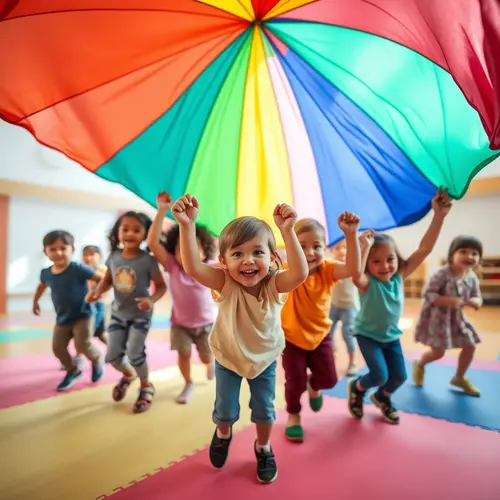
Parachute Play engages entire classes simultaneously. Children hold the edges of a colorful parachute and work together to make waves, bounce balls, or create a “mushroom” by lifting it high.
This activity teaches cooperation because success requires coordinated effort. It also strengthens shoulder and arm muscles through sustained lifting movements.
Follow the Leader combines imagination with movement. The leader demonstrates an action—hopping, spinning, crawling—and others copy. Rotate leaders every minute so every child gets a turn leading.
Running and Agility Games
Red Light, Green Light never goes out of style. One person calls “green light” (children run forward) or “red light” (everyone stops). Those who don’t stop fast enough return to the starting line.
The game naturally teaches acceleration and deceleration. Children learn to control their momentum, a skill that transfers to playground safety.
Tag Variations get hearts pumping. Try “Turtle Tag” where tagged children must freeze on hands and knees until a friend crawls under them to free them. Or “Stuck in the Mud” where frozen players stand with legs apart.
Obstacle Course Design Principles
Creating effective obstacle courses for pe games for preschoolers requires thoughtful station selection. Include 5-7 stations maximum to prevent overwhelm.
Sample stations include: crawling through a tunnel, jumping over pool noodles, walking across a balance beam, tossing bean bags into a bucket, and doing five jumping jacks at the end.
Rotate courses weekly to maintain interest. Use colorful visual cues—arrows on the floor, numbered stations—to help children remember the sequence independently.
Safety Protocols Teachers Must Follow
Every game requires active adult supervision. Position yourself where you can see all children simultaneously. Watch for signs of fatigue—flushed cheeks, heavy breathing, requests to sit out.
Hydration breaks should happen every 15-20 minutes. Even though sessions are short, preschoolers become dehydrated quickly during active play.
Check equipment daily for damage. Frayed ropes, deflated balls, or cracked cones pose injury risks. Replace worn items immediately rather than working around them.
Common Mistakes to Avoid
The biggest error educators make is choosing games designed for older children and simplifying them. This rarely works. Preschoolers need activities built specifically for their developmental stage.
Competitive games where children are eliminated don’t work well at this age. Being “out” equals being excluded, which damages participation enthusiasm. Use inclusive variations where everyone stays active.
Lengthy verbal instructions kill engagement. Demonstrate games physically instead of explaining them. Children learn faster by watching and doing than by listening.
Expert Opinion: The Play-Based Learning Advantage
Having observed thousands of preschool PE sessions, one truth stands out: the most effective pe games for preschoolers don’t feel like exercise at all. When children are pretending to be hopping bunnies or flying airplanes, they forget they’re working on bilateral coordination and cardiovascular endurance.
The play-based approach contradicts the structured drill-and-practice method some programs use. Drills might look impressive to parents, but they don’t produce better long-term outcomes. Children who experience movement as joyful play maintain higher activity levels throughout elementary school.
Adapting Games for Different Abilities
Inclusive pe games for preschoolers accommodate various developmental levels within the same activity. For Animal Walks, allow slower speeds or fewer repetitions for children still mastering the pattern.
Children with mobility challenges can participate in modified ways. During Freeze Dance, wheelchair users can freeze their hand movements. During Red Light Green Light, they can roll forward during green light.
The goal is ensuring every child experiences success and joy during movement time, regardless of where they fall on the developmental spectrum.
Implementing Games in Limited Spaces
Not every program has access to a gymnasium. Many pe games for preschoolers work perfectly in classroom spaces when furniture is pushed aside.
Stationary games like Freeze Dance, Simon Says, and Animal Walks require only 10×10 feet per child. Rotate high-energy games with calmer activities to prevent collisions in tight quarters.
Outdoor spaces offer more freedom but introduce weather variables. Have indoor backup games ready for rainy days. Consistency matters more than space size when building movement habits.
Measuring Progress Without Testing
Assessment in preschool PE happens through observation rather than formal testing. Watch for improvements in specific skills over weeks—can they now catch a ball thrown from 6 feet away when they couldn’t at 4 feet?
Document progress through photos or brief notes rather than quantitative scores. “Marcus completed the obstacle course independently for the first time” tells a more meaningful story than a numerical rating.
Share observations with families to reinforce learning at home. When parents understand which skills their child is developing, they can support practice through active play outside of school.
Building a Year-Long Curriculum
Effective programs cycle through different pe games for preschoolers based on seasons and developmental progression. Start the year with simple individual activities, then gradually introduce partner and group games as social skills strengthen.
Fall might focus on running and jumping games. Winter brings indoor coordination activities. Spring allows outdoor exploration with nature-themed movement games.
This cyclical approach keeps content fresh while systematically building skills. Children encounter each game type multiple times throughout the year, allowing for mastery through repeated exposure.
The right pe games for preschoolers create positive associations with physical activity that last a lifetime. By choosing developmentally appropriate games, maintaining safety standards, and keeping activities joyful, educators give children the gift of confident, capable bodies ready to explore their world.
Hi, I'm Syarafull! I'm a sports enthusiast active in international youth organizations — today's sweat is an investment in the future. Here, I share guides on school sports, fitness, equipment, and peak-performance strategies. I have published 2,335 sports guides here since 2022.


More Stories
The Ultimate Guide to Mastering the Crows and Cranes Game
Youth Fitness: 7 Ways to Beat Chicken Fat for Kids
15 Proven Wellness Activities for High School Students