
Table of Contents
Abilities youth fitness programs focus on building foundational physical competencies that prepare young athletes and active children for lifelong movement success. These programs prioritize age-appropriate skill development, movement literacy, and comprehensive physical preparation over single-sport specialization or premature performance training.
Understanding the Core Framework of Abilities Youth Fitness
Youth fitness programming differs fundamentally from adult training protocols. The National Strength and Conditioning Association emphasizes that prepubescent and adolescent populations require developmentally appropriate progressions that respect biological maturation stages.
Effective programming targets multiple physical domains simultaneously. Coordination, balance, agility, strength, endurance, flexibility, and speed all develop through integrated movement patterns rather than isolated exercises.
The concept of physical literacy forms the foundation. According to research published in the Journal of Sports Sciences, physically literate children demonstrate competence across fundamental movement skills, which directly correlates with sustained physical activity participation into adulthood.
The Seven Essential Physical Competencies
Abilities youth fitness systems should systematically develop these core capacities:
1. Fundamental Movement Skills for Abilities Youth Fitness
Locomotor skills like running, jumping, skipping, and hopping establish baseline movement competency. Object control skills including throwing, catching, kicking, and striking build hand-eye coordination and spatial awareness.
Stability skills such as balancing, twisting, and landing teach body control under various conditions. The CDC Physical Activity Guidelines for Americans recommend that children spend significant time mastering these patterns before progressing to sport-specific techniques.
2. Relative Strength Development
Building strength relative to body weight creates injury resilience and movement efficiency. Bodyweight exercises, partner drills, and resistance band work provide appropriate loading for younger populations.
Progressive overload principles apply even without traditional weightlifting. Increasing movement complexity, tempo variation, and volume creates adaptation without requiring external resistance that may compromise joint integrity in growing bodies.
3. Multi-Directional Speed and Agility
Linear sprinting represents only one dimension of movement capacity. Change of direction ability, reactive agility, and multi-planar movement prepare youth for diverse athletic demands.
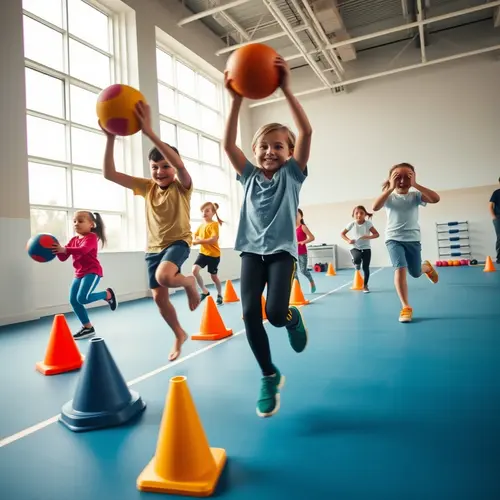
Cone drills, tag games, and reactive movement challenges develop the neuromuscular coordination necessary for complex sport situations. These activities also enhance decision-making speed and perceptual awareness.
4. Cardiovascular Conditioning Through Play
Structured play-based activities naturally develop aerobic capacity without the monotony of traditional endurance training. Tag variations, relay races, and small-sided games maintain engagement while building work capacity.
Interval-based activities mirror the intermittent nature of most youth sports. Short bursts of high-intensity effort followed by active recovery periods match physiological demands of actual competition.
5. Flexibility and Joint Mobility
Dynamic mobility work prepares the body for movement demands while static stretching supports recovery and range of motion maintenance. The American Academy of Pediatrics notes that flexibility training reduces injury risk when integrated appropriately.
Age-specific flexibility protocols account for growth-related tightness, particularly during rapid growth phases. Hip mobility, thoracic spine rotation, and ankle dorsiflexion deserve particular attention across developmental stages.
6. Coordination and Body Awareness
Proprioceptive development occurs through challenging balance conditions, unstable surfaces, and complex movement sequences. Single-leg exercises, balance beam work, and coordination ladders build spatial awareness.
Cross-body movements that integrate both hemispheres enhance neural development. Activities requiring simultaneous upper and lower body coordination create cognitive-physical integration.
7. Mental Resilience and Effort Tolerance
Physical challenges teach perseverance, focus, and emotional regulation. Progressive difficulty increases build mental toughness alongside physical capacity.
Encouraging process-oriented feedback rather than outcome-focused praise develops growth mindset. Children learn to value effort and improvement over innate talent or immediate success.
Age-Appropriate Programming Guidelines
| Age Range | Primary Focus | Training Characteristics | Volume Considerations |
|---|---|---|---|
| 6-9 years | Fundamental movement skills | Play-based, high variety, low structure | 30-45 minutes, 3-5x weekly |
| 10-12 years | Movement refinement, strength introduction | Structured skill work, bodyweight resistance | 45-60 minutes, 4-6x weekly |
| 13-15 years | Strength development, power introduction | Progressive loading, technique emphasis | 60-75 minutes, 5-6x weekly |
| 16-18 years | Performance optimization, specialization | Sport-specific, periodized programming | 75-90 minutes, 5-7x weekly |
Common Misconceptions in Youth Training
The myth that resistance training stunts growth persists despite overwhelming contradictory evidence. Research published in Pediatrics demonstrates that properly supervised strength training enhances bone density and promotes healthy growth patterns.
Early sport specialization represents another widespread error. The American Orthopaedic Society for Sports Medicine reports higher injury rates and burnout among early specializers compared to multi-sport participants.
Abilities youth fitness approaches prioritize broad physical development over narrow skill acquisition. This foundation supports long-term athletic development and reduces overuse injury risk.
Abilities Youth Fitness : The Physical Literacy Gap
Modern youth populations demonstrate declining fundamental movement competency compared to previous generations. Reduced unstructured play time, increased screen exposure, and earlier sport specialization contribute to this deficit.
Programs that reintegrate broad movement experiences address this gap. Coaches and parents must recognize that sport-specific training cannot replace comprehensive physical development during formative years.
The most successful youth athletes typically participate in multiple sports and maintain diverse physical activities. This variety builds adaptable movement capacity and prevents pattern overload.
Implementation Strategy for Coaches and Parents
Assessment precedes programming. Functional movement screening identifies limitations requiring attention before advancing training complexity.
Session structure should balance skill acquisition, physical conditioning, and enjoyment. The 70-20-10 principle suggests 70% time on foundational skills, 20% on physical qualities, and 10% on competitive elements.
- Begin every session with dynamic movement preparation addressing multiple planes of motion
- Incorporate skill progressions that build systematically from simple to complex
- Use games and challenges to maintain engagement while developing physical qualities
- Provide specific, actionable feedback focusing on movement quality rather than outcomes
- Monitor training load through session difficulty ratings and recovery indicators
- Adjust volume and intensity based on growth velocity and biological maturation
Long-Term Athletic Development Perspective
Youth training represents investment in future capacity rather than immediate performance extraction. The principle of delayed gratification applies strongly to physical development.
Children who build comprehensive movement foundations demonstrate superior long-term outcomes compared to early specializers. This approach requires patience from coaches and parents who may prioritize short-term competitive success.
Biological age varies significantly from chronological age during adolescence. Programming must account for individual maturation status rather than applying uniform standards across age groups.
Maximizing Abilities Youth Fitness Outcomes
Successful programs balance structure with autonomy. Children need guided instruction alongside opportunities for creative movement exploration.
Social elements enhance adherence. Peer interaction, team challenges, and collaborative activities increase engagement while building communication skills.
Regular assessment tracks progress across multiple domains. Movement competency evaluations, fitness testing protocols, and subjective enjoyment measures provide comprehensive feedback on program effectiveness.
The ultimate goal of abilities youth fitness programming extends beyond athletic performance. Building confident, capable movers who maintain active lifestyles throughout their lifespan represents the true measure of success. Programs that prioritize comprehensive development over narrow specialization create resilient athletes prepared for diverse physical challenges.
Hi, I'm Syarafull! I'm a sports enthusiast active in international youth organizations — today's sweat is an investment in the future. Here, I share guides on school sports, fitness, equipment, and peak-performance strategies. I have published 2,335 sports guides here since 2022.


More Stories
PE Games: 15 Essential Activities for Engagement
5 Proven Wellness Games and Activities That Actually Work
15 Best Holiday Kid Games for Memorable Celebrations