
Table of Contents
Why Standard Drills Fail This PE Games Age Group
Adolescents crave autonomy and social connection. Traditional elimination games often sideline the kids who need movement most. Research from the Centers for Disease Control and Prevention (CDC) emphasizes that PE programs should prioritize moderate-to-vigorous physical activity (MVPA) for at least 50% of class time. Games with constant motion and inclusive rules hit this metric far better than knockout tournaments.Top 5 fun pe games for high school students for Large Groups
These selections work with 30+ students, minimal equipment, and limited setup time. Each game scales difficulty organically so varsity athletes and reluctant movers stay engaged simultaneously.1. Gaga Ball (Octagonal Pit)
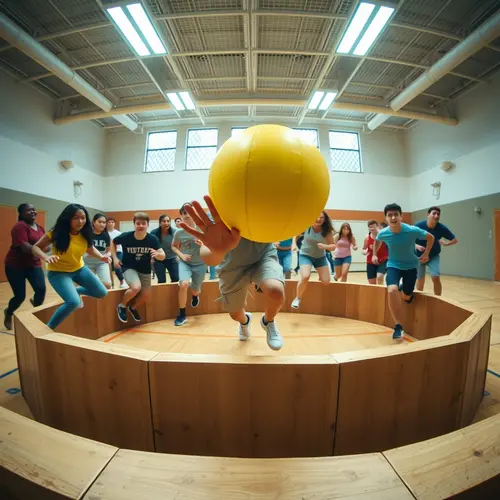
Originating in Israeli camps, this dodgeball variant keeps everyone moving. Players strike a soft ball with open hands, aiming below the knee. Once hit, a student exits the pit but re-enters after completing a quick physical challenge—ten burpees or a lap around the gym—eliminating the “sit and watch” problem. The enclosed space forces lateral shifts and reaction sprints, driving heart rates into the aerobic zone within minutes.2. 9 Square in the Air
Think four square elevated vertically. Nine squares suspended by PVC piping create a 3D grid. The “King” serves from the center square; players rotate up after errors. The vertical plane demands jumping, overhead striking, and spatial awareness. It accommodates mixed athleticism because height matters less than anticipation and ball control.3. Ultimate Handball
Combine Ultimate Frisbee rules with a soft foam ball. No running with the ball; pivot foot only. Turnovers happen on drops or interceptions. The smaller ball increases passing frequency and reduces the “long bomb” dominance seen in disc games. It teaches give-and-go movement patterns directly transferable to basketball and soccer.4. Tchoukball
A non-contact Swiss invention rebounding off angled frames. Teams score by throwing the ball off the frame so the opposition cannot catch the rebound before it hits the floor. The “no defense on the body” rule removes physical intimidation. The International Federation of Tchoukball (FITB) notes the sport develops bilateral coordination and strategic shooting angles—high cognitive load, high cardio yield.5. Speedball (Hybrid Soccer/Handball)
Ball on the ground? Soccer rules. Ball in the air? Handball rules (three steps, three seconds). Transitioning between modes forces constant decision-making. Goalkeepers use hands; field players cannot. This hybrid creates chaotic, hilarious moments that mask the intense interval training occurring underneath.PE Games Comparison: Equipment Needs vs. MVPA Potential
| Game | Equipment Cost | Setup Time | MVPA Potential | Skill Floor |
|---|---|---|---|---|
| Gaga Ball | Low (Pit + Ball) | 5 Minutes | High | Very Low |
| 9 Square | Medium (PVC/Straps) | 10 Minutes | Medium-High | Low |
| Ultimate Handball | Very Low (Foam Ball) | Instant | High | Medium |
| Tchoukball | High (Frames) | 15 Minutes | High | Medium-High |
| Speedball | Very Low (Ball/Cones) | Instant | Very High | Medium |
Small-Sided Modifications for Limited Space
When the gym is double-booked or weather forces classes into a cafeteria, shrink the game, don’t cancel it. 3v3 King of the Court rotations on a badminton court keep intensity high. Use “Make It, Take It” scoring: the scoring team stays on defense, the waiting team challenges. This format guarantees rest intervals match work intervals naturally.PE Games Indoor Adaptation: fun pe games for high school students in Tight Quarters
Wall Ball requires one tennis ball and a solid wall. Two players alternate throwing the ball against the wall; the return must be caught cleanly or the thrower earns a point. Add a “force non-dominant hand” rule every third round. It sharpens hand-eye coordination and reaction time in a 10×10 footprint. I have seen varsity quarterbacks and theater kids equally obsessed with the rhythm of this drill.Assessment Integration Without Killing the Vibe
Grading participation kills intrinsic motivation. Instead, use SHAPE America Grade-Level Outcomes as invisible benchmarks. Observe: Does the student move to open space? Do they communicate on defense? Can they self-officiate a dispute? Record notes on a clipboard during water breaks. The game stays pure; the data gets captured.- Cognitive Check: Pause play for 30 seconds; ask “Where is the weak side?”
- Affective Check: Note who high-fives opponents after a good play.
- Psychomotor Check: Track successful catches/throws per minute via sampling.
Common Pitfall: Over-Refereeing
The biggest mistake I see new teachers make is blowing the whistle for minor infractions. High schoolers need flow. Adopt the “Advantage Rule” from soccer: if the non-offending team keeps possession, let play continue. Address the foul at the next dead ball. This preserves tempo and teaches students to play through contact—a life skill far more valuable than a free throw. Selecting the right fun pe games for high school students transforms a mandatory credit into the highlight of a teenager’s day. Prioritize constant motion, low exclusion, and rules that reward creativity over raw power. The sweat takes care of itself.Rotate games weekly: fun pe games for high school stay fresh when formats change before boredom sets in. Debrief each session with PE games fundamentals and recovery ideas from wellness activities. Standards at SHAPE America back every pick. Coaches running fun pe games for high school with energy rarely fight apathy.
Safety rounds out planning: inspect equipment monthly, set clear boundaries and keep first-aid within reach. Brief students on rules before each rotation starts. End every session with a two-minute cooldown and quick team cheer.
What fun pe games for high school work in small gyms?
Fun pe games for high school adapt to small gyms through small-sided formats and station rotations. Split classes to keep everyone moving.
How do we handle mixed skill levels?
Use handicaps, mixed teams and role rotations. Every student contributes when rules reward more than scoring.
How long should each game run?
Ten to fifteen minutes per game sustains intensity. Rotate before energy dips, not after.
Hi, I'm Syarafull! I'm a sports enthusiast active in international youth organizations — today's sweat is an investment in the future. Here, I share guides on school sports, fitness, equipment, and peak-performance strategies. I have published 2,335 sports guides here since 2022.

More Stories
Youth Fitness: 7 Ways to Beat Chicken Fat for Kids
15 Proven Wellness Activities for High School Students
15 Fun PE Games for Preschoolers That Build Motor Skills